
Patria Credit as a Key Driver of Rural Development in Romania
A new nationwide study on the social impact of microfinance confirms that Patria Credit IFN plays a central role in fostering rural development in Romania. Financed by the Council of Europe Development Bank (CEB) through the InvestEU Advisory Hub, the research highlights how access to microfinance contributes not only to business growth but also to economic inclusion, household well‑being, and community resilience in underserved rural areas.
Patria Credit IFN, the oldest non‑banking financial institution dedicated to financing farmers and small businesses in Romania, emerges from the study as a cornerstone of local development. Its lending activities support disadvantaged communities by enabling investment, stabilising incomes, and strengthening social and economic participation.
Robust Methodology and National Coverage
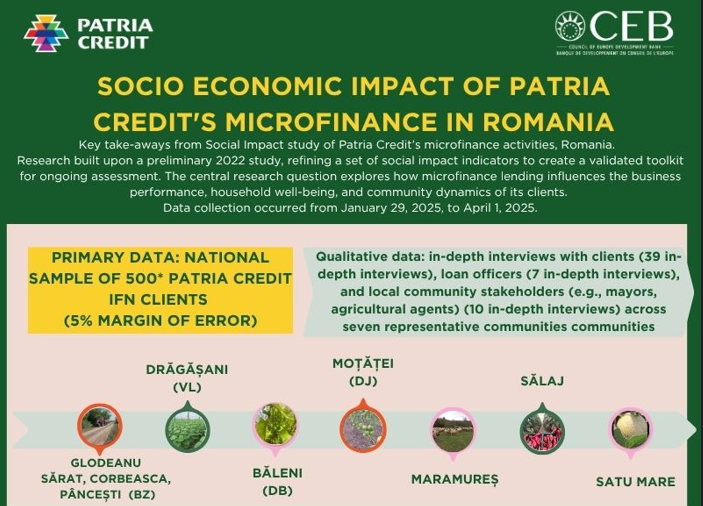
The study was conducted at national level using a mixed‑methods research design that combined quantitative and qualitative approaches. Primary quantitative data were collected between 29 January and 1 April 2025 through a national survey of 500 Patria Credit IFN clients, ensuring a margin of error of 5%. The sample included 400 long‑term clients, with more than 24 months of collaboration with Patria Credit IFN, and 100 new clients who had received their first loan within the previous two years.
To complement the survey data, qualitative research included 39 in‑depth interviews with clients, seven interviews with loan officers, and ten interviews with local community stakeholders such as mayors and agricultural agents. Field research covered seven representative communities across Romania, including Dolj, Vâlcea, Dâmbovița, Buzău, Bacău, Sălaj, Maramureș, and Satu Mare counties. These locations expanded on the geographic scope of the first social impact study conducted in 2022, allowing for a broader and more robust national assessment.
The new study also revised and improved the social impact assessment toolkit developed in 2022, strengthening its relevance and analytical depth.
High Social Impact Performance
Applying the revised toolkit to Patria Credit IFN resulted in a score of 32 out of 36 points, classifying the institution as high performing in terms of social impact. The evaluation covered four key dimensions: financial inclusion, business development, household well‑being, and community development.
In the area of financial inclusion, the results show that Patria Credit IFN reaches clients well beyond the traditional banking system. Half of the surveyed clients rely exclusively on Patria Credit IFN for their financing needs, while 28% are unbanked. Loans are primarily directed to agriculture, with 72% used for equipment purchases, alongside land acquisition, livestock, and construction. This dimension received 10 out of 12 possible points.
Supporting Business Growth and Economic Activity
The study confirms that access to microfinance has a tangible impact on business development. Nearly half of the clients reported an increase in profits, and 96% invested in business assets over the past three years. Interestingly, newer clients demonstrated strong economic dynamism, with average monthly incomes higher than those of long‑term clients. At the same time, high operational costs and taxes were identified by 85% of respondents as the main barriers to further growth. Patria Credit IFN achieved the maximum score in this category, reflecting the strong contribution of its financial services to enterprise development.
Improving Household Well‑Being
Beyond business outcomes, the study highlights improvements in household living conditions. Almost all clients own their homes, which are increasingly equipped with modern amenities and, in some cases, renewable energy solutions. Financial resilience is also strengthening, particularly among newer clients, who show higher levels of savings. Investment in education is rising as well, with families increasingly prioritising higher education opportunities for their children. This dimension received a full score, underlining the broader social benefits of access to finance.
Strengthening Communities and Empowering Women
Community‑level effects are another key finding of the research. Although only 24% of Patria Credit IFN clients are women business owners, women are involved in 88% of the financed businesses, highlighting their essential role in family enterprises and local economies. Microfinance provided by Patria Credit IFN supports local solidarity and economic resilience, particularly in areas where job creation is still at an early stage. Ten percent of beneficiaries currently employ permanent staff, indicating potential for further employment growth. The institution scored 7 out of 9 points in this category.
Voices from the Field
“This study confirms what we see every day in the field: access to finance transforms lives and communities,” said Raluca Andreica, CEO of Patria Credit IFN. “Our clients are building stronger businesses, sending their children to higher education, and shaping a more resilient rural Romania. At Patria Credit, we are proud to expand opportunities where they are needed most.”
Tanja Faller, Director of the Technical Assessment and Monitoring Directorate at the Council of Europe Development Bank, added: “Supporting institutions that combine financial sustainability with measurable social impact is at the heart of CEB’s mandate. Patria Credit IFN is proving to be a catalyst for inclusive growth, directly advancing European priorities on the social economy and rural development.”
A Comprehensive Assessment of Microfinance Impact
By complementing the 2022 research with new data from an expanded geographic sample, this study represents one of the most comprehensive evaluations of microfinance impact in Romania to date. It demonstrates how microfinance can strengthen economic activity, improve quality of life, and empower women and youth, while also pointing to ongoing challenges such as limited job creation and the slower adoption of modern technologies in rural areas.
The study was carried out under the scientific coordination of Claudia Petrescu, Researcher at the Research Institute for Quality of Life of the Romanian Academy, and Dr. Roxana Florența Săvescu, Associate Professor at Lucian Blaga University of Sibiu.