
Capacity Building Needs 2025: Empowering Social Finance Providers for the Future
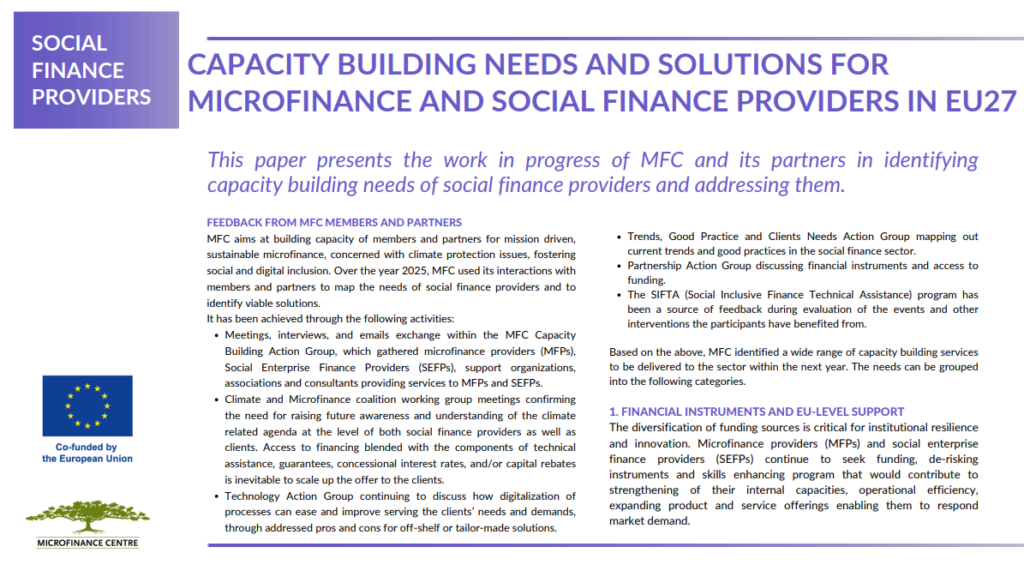
The Microfinance Centre (MFC) and its partners have conducted an in-depth assessment of the capacity building needs of social finance providers across the EU27. Their work, grounded in feedback from members, partners, and sector experts, highlights the evolving landscape of microfinance and social enterprise finance, with a strong focus on sustainability, digitalisation, and social impact.
Key Capacity Building Areas
1. Financial Instruments and EU-Level Support
Diversifying funding sources is essential for the resilience and innovation of microfinance providers (MFPs) and social enterprise finance providers (SEFPs). There is a growing need for access to guarantees, grants, and alternative funding models, especially for underserved groups such as new entrepreneurs, migrants, and refugees. Capacity building in this area includes training on application procedures for EU funding, financial modelling, and compliance with reporting standards.
2. ESG Integration and Strategic Alignment
Environmental, Social, and Governance (ESG) frameworks have become institutional imperatives. Social finance providers must now embed ESG principles into their operations to meet regulatory and investor expectations. This involves developing ESG metrics, integrating ESG into risk management, and ensuring transparent communication about outcomes.
3. Green Finance and Energy Transition
Green finance is a key driver for environmental sustainability and portfolio diversification. Providers are increasingly interested in products that support renewable energy, energy efficiency, and the circular economy. Capacity building topics include designing green loans, environmental risk assessment, and CO₂ emissions tracking.
4. Digitalisation and Artificial Intelligence
Digital transformation is a top priority, enabling providers to better serve clients, automate processes, and enhance decision-making. Training is needed in areas such as AI-driven credit scoring, cybersecurity, digital literacy, and compliance with AI-related legislation.
5. New Product Development and Lifecycle Management
Agile methodologies and user-centred design are being adopted to improve product-market fit and operational efficiency. Providers need support in product development, risk documentation, usability testing, and leveraging AI in product innovation.
6. Social Economy and Inclusive Finance
The social economy encompasses organisations focused on community impact and social goals. Inclusive finance is vital for addressing socio-economic disparities, with tailored services for vulnerable groups. Capacity building includes experience sharing, social impact measurement, and developing products for migrants, women, and rural entrepreneurs.
7. Risk Management and Institutional Governance
Robust risk management frameworks are essential for financial stability and ethical support of at-risk communities. Training is needed in credit analysis, early warning systems, business continuity planning, and governance for boards and leadership teams.
8. Strategic Communication, Marketing, and Sales
Effective communication strategies align mission-driven narratives with targeted marketing and sales plans. Providers benefit from training in digital marketing, CRM systems, persuasive communication, and customer service.
9. Legal, Compliance, and Organisational Development
Staying up to date with regulations (such as GDPR and AML), optimising HR policies, and fostering leadership skills are crucial for organisational growth and compliance.
Addressing Capacity Building Needs
The MFC identifies two main methods for addressing these needs:
- Experience Sharing: Good practice exchanges and peer-to-peer visits.
- Technical Training: Webinars, virtual and onsite trainings led by field experts.
These approaches ensure that social finance providers are equipped to navigate the challenges of a rapidly changing environment, drive innovation, and deliver meaningful impact to their communities.