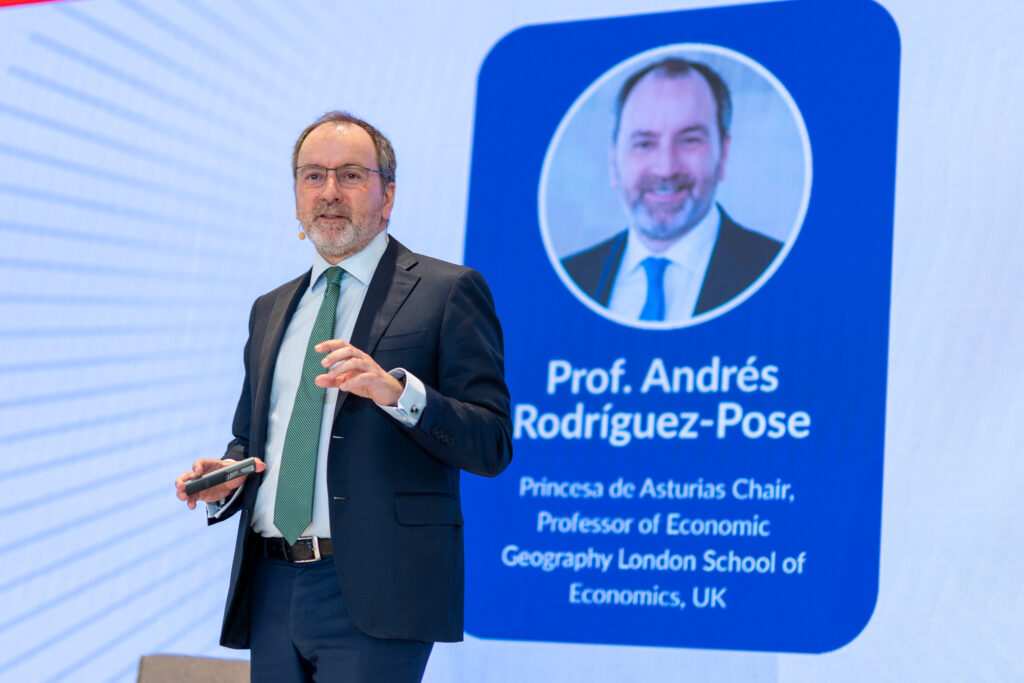
Keynote Speaker: Prof. Andres Rodrigues-Pose
Why do some regions continue to lag behind despite living in an era of unprecedented technological progress and economic growth? In his keynote address Development Traps in a World in Transition, Professor Andrés Rodríguez-Pose explored how economic activity is becoming increasingly concentrated in capitals and major metropolitan areas, leaving many regions across Europe, North America and emerging economies struggling to fulfil their potential. Drawing on research conducted across continents, he argued that these “development traps” represent one of the most pressing economic and political challenges of our time.
Professor Rodríguez-Pose highlighted that the issue is not simply a lack of growth, but the persistent underutilisation of local talent, resources and entrepreneurial capacity. As regions remain trapped in cycles of low productivity, weak job creation and limited opportunities, societies pay a heavy economic and political price. The keynote offered both a diagnosis of these challenges and a call for place-sensitive solutions that build on local strengths, institutions and human potential.
Key Takeaways
Development traps are holding back entire regions
A development trap occurs when a region consistently performs below its own potential, experiencing weaker growth in income, employment and productivity compared to its historical trajectory and the wider economy. According to Professor Rodríguez-Pose, such traps have become widespread across Europe, the United States and emerging economies, affecting regions that struggle to benefit from broader economic progress.
Growth is becoming increasingly concentrated
Economic activity is concentrating in capitals and major metropolitan areas, while many intermediate cities and regions are losing ground. Examples can be found across Europe, from parts of Italy, Croatia, Romania and Greece to regions in Ireland that lag behind the success of Dublin and Cork. Similar patterns are visible in the United States and Kazakhstan, where prosperity remains concentrated in a limited number of locations.
The cost of ignoring regional potential is enormous
One-third of the EU population lives in regions that have recorded very low growth since 2000. Professor Rodríguez-Pose warned that failing to invest in these places means wasting talent, overlooking productive capacity and weakening the foundations of national economies. Simply encouraging people to move elsewhere or relying on subsidies does not address the root causes of regional stagnation.
Development traps can fuel political instability
Economic exclusion often has political consequences. Regions that feel left behind are more likely to experience growing dissatisfaction with established institutions, creating fertile ground for populism, anti-system movements and social unrest. Professor Rodríguez-Pose argued that economic and political challenges reinforce one another, creating a self-perpetuating cycle that becomes increasingly difficult to break.
Place-sensitive policies are more effective than one-size-fits-all solutions
The keynote challenged approaches based on copying successful innovation hubs or pursuing place-blind investment strategies. Instead, development policies should build on the specific assets, capabilities and opportunities that already exist within each region. Lasting progress requires patience and a deep understanding of local circumstances.
Institutions matter as much as investment
Strong institutions, education systems, training opportunities and skills development are critical ingredients for unlocking regional potential. Professor Rodríguez-Pose emphasised that funding alone is not sufficient; regions need the institutional capacity to support entrepreneurship, innovation and long-term development.
Microfinance has a vital role to play
Microfinance can help individuals and communities make the most of their existing potential by providing access to financial resources that would otherwise remain out of reach. By enabling people to pursue opportunities, start businesses and invest in their futures, microfinance contributes to economic inclusion and sustainable local development.
Digitalisation and AI should support local transformation
Rather than focusing solely on generating breakthrough technologies, regions should prioritise helping businesses adopt digital tools and artificial intelligence. Supporting firms to modernise, become more productive and reinvent themselves can play a significant role in overcoming development traps and creating new opportunities for growth.
Unlocking potential requires long-term commitment
Professor Rodríguez-Pose concluded that overcoming development traps will require sustained investment in people, institutions and local capabilities. The greatest opportunities for future growth may not lie in already successful capitals and innovation hubs, but in the regions whose talent and potential have remained underutilised for far too long.

Speakers:
- Archil Bakuradze – Council Chair, Microfinance Centre; Member of the Supervisory Board, Bank Crystal, Georgia
- Sébastien Duquet – Director, Mirova, France
- Olga Tomash – Founder, Tomash Consulting, Netherlands
- Nicolas Blondeau – Fund Manager, Inpulse, Belgium
- Thomas Eriksson – Regional Director for Eastern Europe, Central Asia and the Middle East, Green Climate Fund
As microfinance institutions mature, attract new investors, and navigate changing market conditions, how can they preserve their social mission while ensuring access to the capital needed for growth?
This panel discussion from the MFC Annual Conference 2026 explores the complex relationship between purpose, ownership transitions, impact investing, and the future direction of the microfinance sector. Speakers examine how institutions can remain mission-driven while adapting to changing investor expectations, evolving financial inclusion challenges, and emerging opportunities such as climate finance.
During the session, participants discuss how geopolitical shifts, changing investment priorities, and evolving market realities are influencing the flow of impact capital and creating new challenges for mission-driven financial institutions. The conversation highlights practical approaches to governance, responsible exits, climate finance, and preserving purpose during ownership transitions.
Key takeaways from the session:
✅ Financial inclusion is evolving from simply providing access to finance toward delivering responsible financial services that are fair, transparent, and client-focused.
✅ Access to impact-aligned capital is becoming more challenging as investors increasingly prioritise sectors such as defence, artificial intelligence, and domestic investments.
✅ Climate finance presents significant opportunities for microfinance institutions, particularly in supporting climate adaptation, resilient agriculture, renewable energy, and energy efficiency at the local level.
✅ Institutions should remain authentic to their mission and clearly communicate their social value rather than rebranding themselves to follow funding trends.
✅ Ownership transitions require careful planning from the outset to safeguard institutional purpose and avoid mission drift when investors exit.
✅ Growth should not be pursued at any cost; organisations should balance expansion with maintaining quality, governance standards, and social impact.
✅ Strong governance, transparent impact reporting, and clear social objectives are essential for attracting mission-aligned investors.
✅ The European Commission reaffirmed that poverty reduction, support for vulnerable groups, gender equality, and rural inclusion remain central priorities for European microfinance policy.
✅ Speakers called for the creation of common social and environmental standards and rating mechanisms to make it easier for investors to identify and support mission-driven financial institutions.
The discussion offers valuable insights for microfinance practitioners, investors, policymakers, and development finance institutions seeking to balance financial sustainability with lasting social impact in a rapidly changing environment.
This session was part of the programme of the MFC Annual Conference 2026, one of Europe’s leading events dedicated to inclusive finance, social finance, microfinance, entrepreneurship support, impact investing and financial inclusion.

Speakers:
- Rajesh Mirjankar – Co-founder, Managing Director & CEO, KiyaAI, India
- Don Ginsel – Managing Director, Fintech Aera Foundation, Netherlands
- Seth Spiro – Vice President and Chief Product Officer, FINCA International, USA
- Georgiana Andrei – CEO, Filbo, Romania
- Khalid Kabeer – Chief Product Officer, AdalFi, Jordan
- Alexandra – Inclusive Finance & Responsible AI Strategist
This session from the MFC Annual Conference 2026 explores how AI and digital technologies are reshaping financial services and what this means for financial inclusion.
The discussion examines how MFIs can adopt innovation in a mission-aligned way, improve customer experience, increase operational efficiency and ensure that technological progress supports rather than undermines inclusion.
Key takeaways from the session:
✅ AI is becoming a powerful tool for expanding financial inclusion and improving customer-centric service delivery.
✅ Successful digital transformation should start with customer needs and institutional purpose, not technology alone.
✅ Responsible AI requires strong governance, quality data, transparency, and careful management of risks and bias.
✅ Digital channels can help reach underserved populations, but institutions must ensure that technology remains accessible and inclusive.
✅ Human judgement, trust, and customer relationships remain critical, even as AI capabilities continue to evolve.
✅ MFIs that invest in digital skills, innovation, and organisational adaptability will be better positioned for the future.
This discussion offers practical insights for microfinance practitioners, fintech providers, investors, and policymakers seeking to navigate the opportunities and challenges of AI-driven transformation while advancing financial inclusion.