
Blended Finance and Impact Capital for MFIs
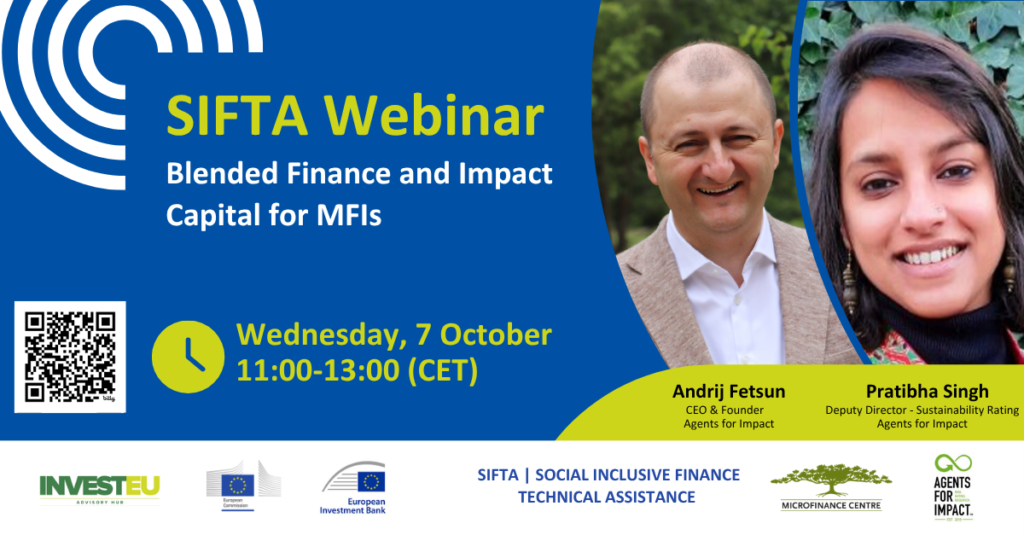
07/10/2026

11.00-13.00 CET

Zoom

English

No charge

Register Now

Blended finance is increasingly becoming an important channel through which MFIs in Europe and beyond keep supporting the clients who matter most to their mission. Capital for microfinance institutions is changing shape.

As grant funding and traditional donor support contract sharply, the funding that still exists arrives as guarantees, concessional tranches and technical assistance facilities: instruments that reduce investors’ risk so that private capital will follow.

Capital that keeps flowing to underserved borrowers, women entrepreneurs, rural clients, and green investments that commercial finance would price out. This is what makes blended finance a social and an environmental tool, not just a funding mechanism. It absorbs first losses so MFIs can keep serving higher cost-high impact clients and climate-smart activities that need patient capital. It can be the bridge that keeps mission-critical lending alive.

This session translates that shift into practice. We open with what has actually changed in the funding landscape and why. We then take the structures apart: what a first-loss tranche, a portfolio guarantee or a TA facility really does, and who carries which risk. We map the funders relevant to EU-27 and beyond, with eligibility, ticket sizes and expectations for each.

Finally, we turn the lens around: what makes an institution fundable, including the social and environmental evidence funders now expect, which due-diligence gaps most often stall an application, and what participants can do about it in the next 90 days. Three real structures are dissected along the way, including one deal that did not work.

Why this topic is particularly relevant and timely:

  • The donor base has shrunk: USAID has wound down, several European bilateral donors have cut development budgets, and the Gates Foundation has announced it will sunset its inclusive financial systems work by 2030. Institutions that relied on concessional or grant-adjacent funding need to re-plan their liability side now.
  • The EU’s own architecture is being redrawn: the EU budget for 2028–2034 is being negotiated in parallel with InvestEU folded into a new competitiveness fund and a dedicated facility proposed for microfinance and the social economy. Decisions taken in Brussels over the coming months will define what MFIs can access for the following seven years.
  • The bar for investors has risen. Funders increasingly expect credit-grade documentation, evidenced environmental and social management, and disclosure that stands up to scrutiny.
  • Social and environmental performance is now part of the funding case, not an add-on. Investors increasingly weight outcomes for and outreach to underserved and vulnerable clients, gender lending, and green portfolio share, alongside credit metrics. MFIs that can evidence this performance access blended structures on better terms.

Key insights and practical takeaways:

By the end of the session, participants will be able to:

  • Recognise the layers of a capital stack and understand what a first-loss tranche, a portfolio guarantee, a concessional loan or a TA facility is doing in a deal and what each one costs them.
  • Leave with a funder map and understand which instruments and windows are open to an institution of their size and jurisdiction, what each funder requires, and where to make first contact.
  • Judge their own readiness by applying a concrete ESG due-diligence checklist — governance, ESMS, social and environmental data — to their own institution and see immediately where the gaps are.
  • Articulate the social and environmental case for their institution that makes blended capital worth deploying.

Who should attend?

The session is designed for senior decision-makers who shape an institution’s funding strategy and can act on it:

  • CEOs and Managing Directors
  • CFOs and Finance Directors
  • Risk Managers
  • Business Development / Investor Relations Officers
  • Social Performance / ESG Managers

as well as Board members involved in governance oversight and funding decisions.

Our Experts

Andrij Fetsun – CEO & Founder, Agents for Impact

Andrij has worked in impact investing since 2015. From 2015 to 2018 he served as the sole Portfolio Manager at Invest in Visions, where he grew the investment portfolio from EUR 98 million to around EUR 700 million.

In 2015 and 2016 he was also Fund Manager of the German Ukrainian Fund, which promotes SME finance in Ukraine. In that role he built the fund’s brand and local presence in the Ukrainian market. During the 2016 currency crisis in Tajikistan, he decided to double the portfolio’s exposure to the country. That portfolio has recorded a 0% default rate to date.

In 2018 Andrij founded Agents for Impact in Germany, an impact investing company that promotes the SDGs in impact finance. During the Covid-19 pandemic in 2020 and 2021, he led the company’s global team, which structured and disbursed debt transactions totalling more than EUR 310 million despite worldwide lockdowns. Since 2018 none of the company’s transactions have defaulted or been restructured.

Andrij holds a PhD in Aviation Engineering and a Master of Finance from the Frankfurt School of Finance and Management.

Pratibha Singh – Deputy Director – Sustainability Rating at Agents for Impact

Pratibha Singh is an Indian development professional with expertise in gender equality, climate change, migration, and conflict management. She has worked across India, Thailand, and Germany in both research and project management roles with NGOs, think tanks, and associations.

With dual Master’s degrees in Gender & Development Studies and Public Policy, she has authored around 40 publications, including articles, policy briefs, and research papers. As an SDG Rating Analyst, she is committed to enhancing the positive impact of financial investments aligned with the UN Agenda 2030.

Currently pursuing her PhD at EBS Universität, she seeks to bridge sustainable finance and SDG research while staying grounded in nature and literature.

Register Now

Our partners